With so many negative reports about aspartame, it is important
to understand how aspartame was approved
In approximately 1967, G.D. Searle, manufacturer of aspartame, first began the process of seeking FDA approval for their artificial sweetener as a food additive.
What followed were years of controversy. Early on, respected neuroscientist and researcher, Dr. John W. Olney, warned the manufacturer that oral intake of glutamate, aspartate and cysteine, the excitotoxic amino acids found in aspartame, cause brain damage in mice. His findings were confirmed by another researcher, Ann Reynolds, who was hired by G. D. Searle. (Claiming an oversight, G. D. Searle did not inform the FDA of this study until after the approval of aspartame.)
Petitions by Dr. Olney prompted an FDA investigation which found G.D. Searle’s testing procedures to be full of inaccurate results and manipulated test data. Following the investigation, a grand jury probe began, but was thwarted six months later when the lead U.S. Attorney assigned to the case, Samuel Skinner, suddenly resigned and accepted a position at the law firm representing G.D. Searle.
About this same time (1977) the battle weary G.D. Searle company sought to turn the situation around by appointing, as their new CEO, former Illinois congressman and Washington “insider” Donald Rumsfeld (most recently the former Secretary of Defense).
Although it took several years, Rumsfeld’s political pull, rather than the scientific evidence, eventually resulted in the approval of Aspartame—through his associations in
When Ronald Reagan (a good friend of G.D. Searle, manufacturer of aspartame) took office in 1981 he fired the current FDA Commissioner who refused to approve aspartame. President Reagan then hired Dr. Arthur Hull Hayes as commissioner. By this time there was so much controversy over aspartame that a Board of Inquiry was established. The Board advised Dr. Hayes not to approve aspartame. Dr. Hayes overruled his own Board and aspartame was approved for use in November 1981. Shortly (four months) after Dr. Hayes won approval for aspartame he left his position as FDA Commissioner and took a lucrative position with G.D. Searle’s Public Relations firm.
Based on widely available information, the FDA approval of aspartame certainly appears to be the result of manipulated data, bribery, deception and political corruption. For the history of aspartame, the following websites provide the pre approval and research data that led to the FDA approval of aspartame:
http://www.holisticmed.com/aspartame/history.faq
http://www.wnho.net/history_of_aspartame.htm
(1983) Even the National Soft Drink Association drafted an objection to permitting the use of aspartame in carbonated beverages. At that time, it was well documented that when liquid aspartame is stored above 85 degrees it breaks down into DKP and formaldehyde, both known toxins. Formaldehyde binds tightly to DNA, making it difficult to remove from the body. And, because it is a "cumulative toxin", even small amounts can become significantly toxic over time
Why is Aspartame is so dangerous?
Aspartame is an excitotoxin—a substance that excites or over-stimulates nerve cells, damaging the nervous system. The nervous system is responsible for carrying information to and from all parts of the body. Symptoms of nervous system damage run the gamut from loss of feeling and tingling, lack of coordination and reflexes, muscle rigidity, to slurred speech and seizures.
An excitotoxin, such as Aspartame, basically excites neural cells to death. This occurs in the brain and in peripheral nerves because the key components in aspartame are absorption accelerants and can easily cross the blood brain barrier. The blood brain barrier is a system of specialized capillary structures that are designed to prevent toxic substances from entering the brain.
Aspartame actually changes the brain’s chemistry. Some people react immediately, but more ominous, is that for many, the damage is slow, silent and can be irreversible with long term use.
Attention Diabetics: The methanol (wood alcohol) in aspartame causes blood sugar levels to go out of control. Diabetics with retinopathy are often misdiagnosed, when in fact it is the methanol that has caused damage to the optic nerve, leading to blindness. And aspartame causes some diabetics to go into a coma.
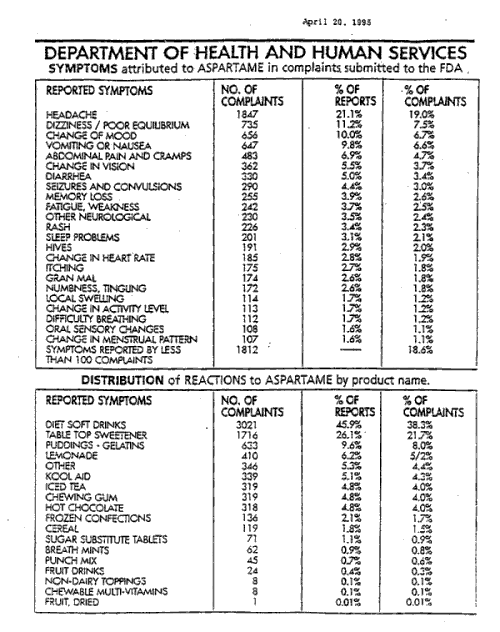
Over 75% of all food related complaints received by the FDA are associated with aspartame
Because of the high volume of complaints, the FDA has documented 92 common aspartame related symptoms. The majority of the symptoms are neurological, because aspartame destroys the nervous system. Some of the most serious are brain tumors, brain lesions, and lymphoma.
Among the most common complaints registered with the FDA are: headache, heart rate irregularities, dizziness, dramatic mood swings, nausea, abdominal pain, blindness, memory loss, muscle weakness, fatigue, rashes, sleep problems, blood sugar problems, sexual dysfunction, difficulty breathing, seizures and convulsions. Independent research shows that seizures are one of the most common reactions to aspartame.
Populations that consume aspartame are known to develop symptoms commonly diagnosed as Multiple Sclerosis, Alzheimer’s, Parkinson’s and Lou Gehrig’s.
NikiNorman Wellness Infotainment


No comments:
Post a Comment